The federal government had one shot to break up the biggest monopoly in live music. They blinked.
On March 9th, the Department of Justice settled its antitrust case against Live Nation and Ticketmaster. No breakup. No divestiture. Just a $280 million payout (roughly four days of Live Nation's annual revenue), some fee caps at a handful of amphitheaters, and a promise to play nicer with competing ticketing platforms.
The trial had been underway for barely a week. Witnesses were testifying about retaliation tactics against venues that dared to use other ticketing services. A jury was seated. And then, just like that, it was over.
The judge presiding over the case, Arun Subramanian, wasn't even told it was coming. He learned about the settlement from an email at 8 PM on a Sunday night, despite both parties having signed a term sheet days earlier while he was still fielding trial motions. In open court, he called the secrecy "disrespect for the court, the jury and this entire process." The 26 states that joined the lawsuit as co-plaintiffs weren't consulted either. They found out about the negotiations through news coverage and were given a single day to decide whether to accept.
They didn't. A bipartisan coalition of 26 states plus the District of Columbia formally rejected the deal. North Carolina's Attorney General called it a "terrible deal" that "falls drastically short of breaking up their monopoly and won't stop them from squeezing fans with absurd fees, trapping artists, and bullying independent venues." New York's AG said the settlement "fails to address the monopoly at the center of this case." Ohio, where Seatfun is based, is among the states continuing to fight.

The political backdrop makes the outcome less surprising. Live Nation added Richard Grenell, one of President Trump's closest advisers, to its board of directors. The DOJ's antitrust division chief, Gail Slater, who was known for aggressive enforcement, was pushed out a month before the settlement. The $280 million payout is less than 1% of Live Nation's annual revenue.
If you're a venue owner, promoter, or independent artist reading this right now, you're probably not surprised. But you should still be angry.
Here's what this settlement actually means for the people running events on the ground, and why this moment is exactly the reason we built Seatfun.
What the Settlement Actually Says (and What It Doesn't)
Let's break down what the DOJ walked away with.
Live Nation agreed to cap Ticketmaster service fees at 15% of the ticket price at venues it owns. It agreed to open up exclusive booking arrangements at 13 amphitheaters. And it agreed to let other ticketing platforms connect to Ticketmaster's underlying technology.
Sounds reasonable on paper, right?
Here's the problem: none of this touches the vast majority of independent venues, local promoters, or emerging artists. The fee cap only applies to Live Nation's own amphitheaters. The booking changes only affect 13 specific locations. And the "open platform" requirement could actually make things worse by giving resale platforms even more access to listings, which fuels the exact scalping problem fans are already furious about.
The National Independent Venue Association didn't hold back either. Their executive director, Stephen Parker, pointed out that the settlement "does not appear to include any specific and explicit protections for fans, artists, or independent venues and festivals." He also warned that requiring Ticketmaster to host resale platform listings could actually empower scalpers, making the price gouging problem worse, not better.
So if the federal government won't protect the independent live music ecosystem, who will?
Update: Leaked Slack Messages Show Live Nation Employees Bragging About Overcharging Fans
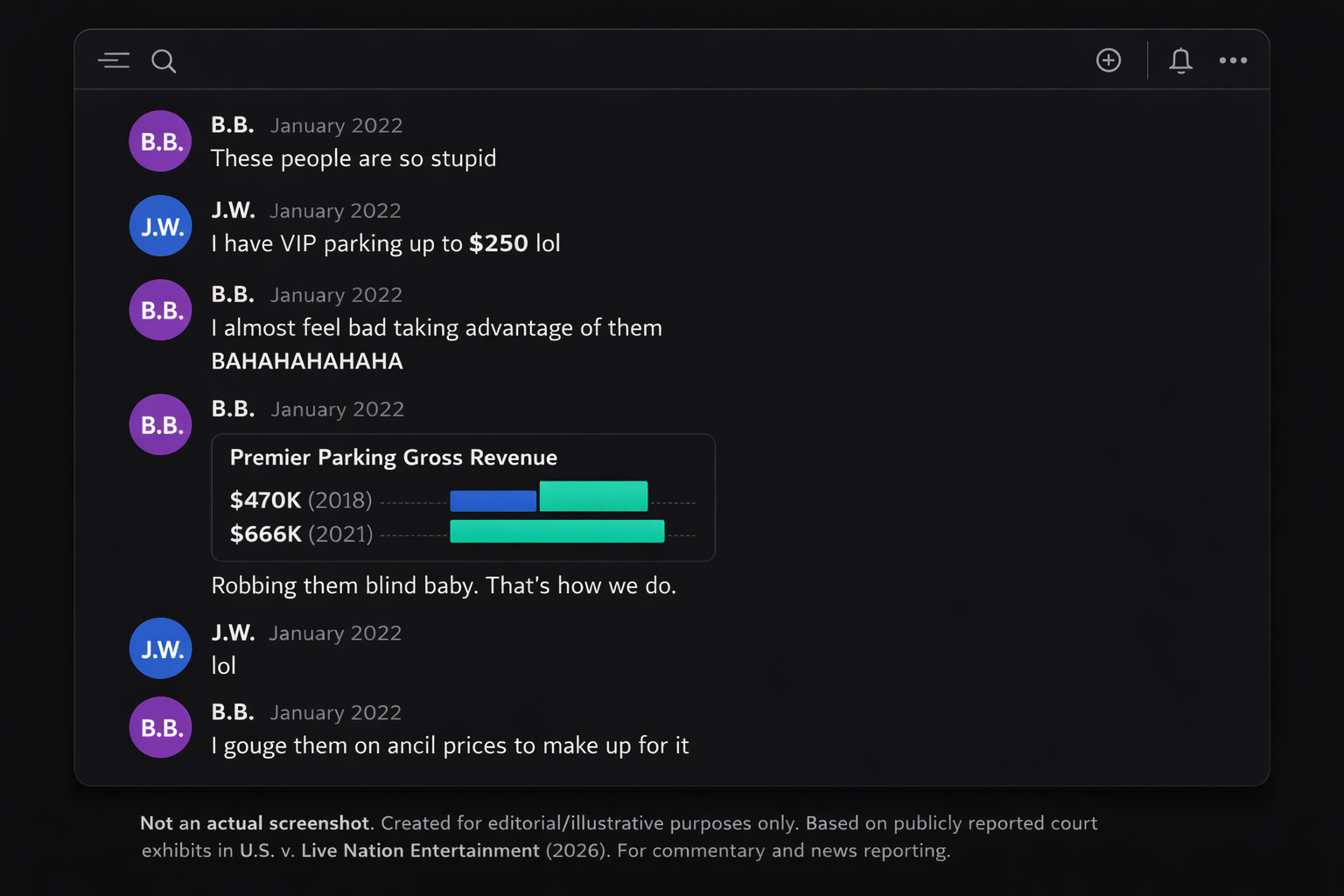
Just days after the settlement was announced, newly unsealed court documents made the situation even uglier.
Internal Slack messages from 2022 between two Live Nation ticketing directors, Ben Baker and Jeff Weinhold, were released as exhibits in the antitrust trial. The messages show the two employees openly joking about gouging fans with inflated ancillary fees for parking, VIP access, and preferred seating at Live Nation amphitheaters.
Baker, who was a regional director of ticketing at the time and has since been promoted to head of ticketing for all of Live Nation's venues, wrote that fans paying his inflated VIP parking prices were "so stupid." He shared screenshots of parking revenue jumping from roughly $470,000 in 2018 to $666,000 in 2021, commenting that the company was "robbing them blind." In another exchange, Weinhold described charging $250 for VIP parking and going "way over cap on VIP Club" because buyers "don't know what they bought."
Live Nation tried to exclude these messages from the trial, arguing they would "inflame the jury." The DOJ pushed back, calling them a "candid, contemporaneous look into how they view prices." Judge Arun Subramanian ordered the documents released in full.
Live Nation responded by calling Baker a "junior staffer" sending messages to "a friend," and said the exchange "absolutely doesn't reflect our values or how we operate." The DOJ and state attorneys general pointed out that Baker was not junior at all. He now oversees ticketing for more than 150 amphitheaters nationally.
Here's why this matters for independent venues: this is the culture at the top of the ticketing industry. Not just the fees. Not just the exclusivity contracts. The people running the largest ticketing operation in the country are on record laughing about how much they can extract from fans before anyone pushes back. And the settlement that was supposed to fix this? It caps service fees at 15% at Live Nation's own venues, but it does nothing about the ancillary fee gouging these messages describe. Parking, VIP, preferred seating, those revenue streams are untouched.
If you needed one more reason to move your ticketing off the platform that treats your fans as marks, this is it.
The Real Problem Isn't Just Ticketmaster. It's the Model.
Here's where most people get it wrong. They think the problem is one company behaving badly. Break up Ticketmaster, and everything gets better.
But the real issue is deeper than that. It's the entire model of how ticketing has worked for decades.
Traditional ticketing platforms operate on volume. More events, more tickets, more fees. They don't care if your 200-cap venue in Ohio has a different set of needs than a 20,000-seat amphitheater in Los Angeles. You're a line item. You get the same bloated fee structure, the same generic dashboard, and the same painfully long wait for your money.
One of our partners at Coach's Corner put it perfectly. They promoted live music for over 20 years and used Eventbrite since 2012. When issues came up, it was nearly impossible to reach a real person. At one point, $20,000 in deposits were held without clear communication, and it took weeks to get answers.
That's not a bug in the system. That is the system.
And a DOJ settlement isn't going to fix it. Because the model was broken before the lawsuit, and it'll stay broken after.
Why Invite-Only Changes Everything
This is where Seatfun's approach is fundamentally different. And it starts with something that might seem counterintuitive: we don't let just anyone on the platform.
Seatfun is invite-only. That's not a gimmick or an artificial scarcity play. It's a deliberate design choice that protects the entire ecosystem: organizers, fans, and the quality of every event on the platform.
Here's why that matters more than ever right now:
It Keeps the Bad Actors Out
When your platform is open to everyone, you inherit everyone's problems. Scalper bots, fake promoters, fly-by-night "event companies" that vanish after collecting ticket revenue. An invite-only model means every venue and promoter on Seatfun has been vetted. Your fans know they can trust the experience, and you know who you're working alongside.
We also block bots before they ever hit your page. Bank-level encryption on every transaction. AI-powered fraud detection. This isn't an afterthought bolted on. It's built into the foundation.
It Creates Real Accountability
When you're part of a curated community, the incentives change. Venues and promoters care about their reputation on the platform because it means something. Fans trust the events listed because every organizer earned their spot. That's the opposite of a volume-first platform where anyone with a credit card can list an "event."
And here's a detail that drives our partners crazy about legacy platforms: cross-promotion. You spend months building an audience and selling tickets to your show, and then the platform uses your audience data to promote a competing event down the street. Seatfun doesn't do that. Ever. Your data stays yours, and we never promote competitor events to your attendees.
It Means We Actually Know You
This is the part that a $25 billion company will never be able to replicate.
Seatfun isn't trying to serve 50,000 venues. We're building deep partnerships with the venues, promoters, and artists who are doing this work every weekend in their communities. When you have a problem, you talk to a real person within minutes. When you need a custom fee structure that fits your venue model, we build it with you. When you need a seatmap for reserved tables and tiered pricing, we don't send you to a help article. We get it done.
One of our partners at The Office Nashville said it best: they've tried every platform out there. Seatfun's team built them a full website, responded within minutes, and became actual partners. "More like SeatFAM."
That's not a support ticket. That's a relationship.
What the Settlement Proved (That We Already Knew)
The DOJ case confirmed something that independent venues have felt in their gut for years: the system is stacked against you. Live Nation controls the promotion, the venues, the ticketing, and the artist management pipeline. And even when the federal government steps in with the full weight of an antitrust trial, the outcome is a wrist-slap that one industry group compared to four days of revenue.
That's the world you're operating in.
But here's the thing. This moment is also proof that you don't have to wait for Washington to fix your problems. You can choose a platform that was built for you from day one.
The settlement requires Live Nation to stop retaliating against venues that use competing ticketing companies. That's great. But you shouldn't need a federal consent decree to feel safe choosing a different ticketing partner. You should just be able to pick the one that works best for your business.
What This Means for You
If you're running events at an independent venue, promoting local shows, or building an audience as an emerging artist, here's what to take away from this moment:
- The big platforms aren't coming to save you. The settlement makes marginal improvements at the top of the market. Your 300-cap room isn't part of that equation.
- Fee transparency matters more than ever. Fans are paying attention to what they're charged at checkout. Work with platforms where the fee structure is built with you, not dictated to you.
- Your data is your lifeline. If your ticketing platform is using your audience to promote competing events, you're paying for the privilege of growing someone else's business. Own your data. Use it for your own SMS campaigns, your own remarketing, your own growth.
- Your payout timeline is your cash flow. If you're waiting a week or two to get paid after an event, that's money you can't reinvest in your next show. Getting paid daily isn't a luxury. It's how you stay in business.
- You have more options than you think. The settlement itself acknowledges that venues should be free to work with multiple ticketing platforms. Take that freedom seriously.
The Future Belongs to the Independents
Live Nation will be fine. They'll pay their settlement, adjust a few contracts, and keep printing money. Their stock went up 6% the day the deal was announced. That tells you everything you need to know about who won.
But the live music industry isn't just arenas and amphitheaters. It's the 200-cap clubs, the outdoor festivals run by three people and a dream, the tribute night at your local theater, the artist building something real one show at a time.
Those people deserve a ticketing partner, not just a platform. One that gives them daily payouts, custom fees, full data ownership, built-in marketing tools, and a team that picks up the phone.
The DOJ settlement didn't change the game. But you can.
Request an invite to Seatfun and see what ticketing looks like when it's actually built for the people running the shows.
Sources
- DOJ settles antitrust case with Live Nation-Ticketmaster, promising fee caps, venue divestitures, and more ticketing options - FindLaw, March 10, 2026
- Live Nation settles antitrust case with Justice Department; Ticketmaster avoids breakup - NBC News, March 10, 2026
- Live Nation Reaches Settlement With U.S. Department of Justice in Antitrust Case - Variety, March 9, 2026
- Live Nation and Justice Department reach settlement in antitrust case - NPR, March 9, 2026
- Justice Department and Live Nation reach settlement over Ticketmaster illegal monopoly case - PBS News, March 9, 2026
- DOJ settles antitrust case with Live Nation and Ticketmaster - Axios, March 9, 2026
- Ticketmaster and Live Nation's settlement with the Department of Justice might finally bring cheaper concerts - Slate, March 10, 2026
- Justice Department, Live Nation reach deal to settle antitrust lawsuit - The Washington Post, March 9, 2026
- Live Nation Settlement: Preliminary Statements from the Industry - Digital Music News, March 9, 2026
- Live Nation Employees Bragged About 'Gouging' Customers and 'Robbing Them Blind' In Dozens of Leaked Exchanges - Digital Music News, March 12, 2026
- Live Nation Employees Brag About Price-Gouging Customers, Calling Them 'So Stupid' in New Court Documents - Variety, March 12, 2026
- Live Nation Employees Brag About 'Robbing' Fans in Unsealed Messages - Rolling Stone, March 12, 2026
- Live Nation Employees Bragged About Overcharging Fans, 'Robbing Them Blind, Baby' - New York Post, March 12, 2026
- Judge scolds Live Nation and Justice Department for secret settlement talks - CNN, March 10, 2026
- States call Ticketmaster-Live Nation settlement a 'terrible deal' and continue their own lawsuits - ABC10/AP, March 10, 2026
- States Plan Legal Action, Revolt Against DOJ's Live Nation Settlement - EDM.com, March 12, 2026